Wednesday, February 18, 2015

MILITARY PENSION (OROP) A REALITY SOON


(SOURCE - TOI)

One rank, one pension likely to be in budget

Feb 18 2015 : The Times of India (Hyderabad)

The much-awaited “one rank, one pension (OROP)'' for the armed forces is   likely to be part of the Union budget, and could be implemented soon thereafter with the government defining “military pension'' as category  separate from other kinds of pension.

An estimated Rs 8,000 cr is likely to be allocated by the government to fulfill its commitment to the over 25 lakh exservicemen, who have been stridently demanding OROP for several years without much success despite all parties   promising its implementation. The UPA Govt had decided to implement OROP and provided a corpus of Rs 500 cr. After coming to power, NDA increased  the amount to Rs 1,000 cr. Governments in the past have contended that granting of full OROP was neither financially nor administratively possible since it could lead to a cascading effect with similar demands being made by paramilitary personnel, among other things.

But sources said the Govt this time has decided that the military personnel,  who retire at a much earlier age and undergo life-threatening postings, can not be equated with other government employees. Both the Finance and Defence Ministers, Arun Jaitely and Manohar Parrikar, have approved the step. OROP basically implies payment of uniform pension to personnel retiring in the same rank with the same length of service, irrespective of their date of retirement. “Military pension as a category has been defined as separate from others based on a series of criteria. This takes into account the hardship factor like being posted in far-flung areas, risky life-threatening duties and long hours of hardship,“ a source said.


(SOURCE-TOI)

ONE RANK ONE PENSION AND OTHER MILITARY VETERAN ISSUES: MYTH BUSTER (By Navdeep Singh)


The very recent assurance on “One Rank One Pension”, or OROP as it is colloquially known, by the Defence Minister of the country should calm some nerves. The Minister, by now known for his sensitive and humane approach, reassured military veterans that he staunchly stood behind the promise made by the Government on the subject time and again, including by the Prime Minister. A case is hence definitely made out not to read too much into the negativity floating around in the environment on the subject.

Why OROP for soldiers some may ask! Common sense is all that is required to fathom that the current cost of living equally applies to a military veteran who retired say fifteen years back vis-a-vis the one who retires today in the same rank. When both go out to the grocer, they pay the same price for atta that they buy, they pay the same for the vegetables which feed their families, they are also expected to maintain a similar level of daily life, so why the sharp difference in their pensions?

Precisely this is the reason why the concept OROP, came into inception. At a rudimentary level, it simply means similar pension for similar rank for an equal length of service. It is not only desirable, but highly logical. Agreeable is the suggestion that ideally it must be applied to all services under the government, military or otherwise, but then we do not live in an ideal world and till that final objective is achieved for all other classes of employees, military veterans do have a case for favourable consideration as explained in the succeeding lines.

As would be expected in any democracy, departments concerned or dealing with the Armed Forces of most nations strongly stand behind their men and women in uniform and plead for the best of benefits from their respective governments. But in our country, the Ministry of Defence (MoD), till recently, was legendary in always taking an adversarial stand against the profession of arms. And not straying from this dubious legacy, it were elements of the same Ministry that always opposed the grant of OROP to military veterans repeatedly citing financial, administrative and legal impediments for resisting the concept, and in the bargain, attempting not only to mislead and misguide the highest of political executive, but even Parliamentary Committees. While financial constraints are well understood and appreciated, there is never too high a price to pay for those who protect us at the peril of their lives. Under the garb of administrative constraints, it was pointed out by the Department of Ex-Servicemen Welfare (DESW) of the MoD to a Parliamentary Committee in 2011 (Koshyari Committee) that OROP was not feasible to implement since documents of military personnel are weeded out after 25 years- an incorrect averment, to say the least. In reality, it is the documents of non-pensioners that are weeded out in 25 years as per Regulation 595 of the Regulations for the Army. Moreover, the Pension Payment Orders (PPOs) of pensioners which contain all relevant details such as the rank last held and the length of service are retained during the lifetime of each pensioner and then during the lifetime of the family pensioner  in case of demise of the former, and  these details, which are the only two basic requirements for OROP, are also available in a document called “Long Roll” which is maintained in perpetuity in terms of Regulation 592 of the Regulations for the Army. Of course, a complaint to the then Raksha Mantri related to false statements by representatives of the MoD to the Parliamentary Committee and also to Constitutional Courts did not elicit any action whatsoever, as expected. Even the legal constraints pointed out by the DESW repeatedly hold no ground since the decision of the Supreme Court in the case of Maj Gen SPS Vains, being the latest on the subject, fully endorses the concept of OROP.

Another strange bogey historically put across by the establishment has been the imaginary fear that “other employees” would also start demanding OROP. This argument too is faulty at multiple levels. Firstly, it is a fact that no civilian pensioners’ body has ever opposed additional pensionary benefits to military veterans and mostly civilian peers have supported the cause, tacitly and even overtly. Secondly, unique service conditions such as living away from the family in a strictly regimented, at times hazardous and highly stressful environment, maintaining two households on being posted away from family, being under a disciplinary code 24 hours a day, 365 days a yearet al make an additional dispensation such as OROP all the more justified. Thirdly, depending upon rank, soldiers start retiring at the age of 34 which is not the case in any other service including comrades of the Central Armed Police Forces who also no doubt face tough service conditions. Fourthly, civil employees are blessed with a much higher lifetime earning as compared to military employees and they also are fortunate to see multiple salary revisions through subsequent pay commissions. Fifthly, a much higher system of calculating pensions remained applicable to the defence services till the third pay commission when it was abruptly discontinued and military pensioners were suddenly (broadly) equated with civilian pensioners in many aspects. Sixthly, the fear of ‘similar demands’ also now does not hold much water since other employees (post-2004) are on a New (Contributory) Pension Scheme which is much different than the traditional pension system of the Government. Seventhly, contrary to popular perception, and interestingly, the average life expectancy of military personnel and veterans is much lower than other civilian employees, especially at the lower ranks.

With a proactive Prime Minister, a sensitive Defence Minister and other former soldiers on Ministerial berths, the new Government has definitely given hope to defence pensioners in the well known demands of the military community in issues such as OROP as well as other insidious matters such as the way disabled soldiers and military widows are treated by the system. The new government, which now seems to be getting a grip of things, however must ensure that the political will in this regard is imposed and enforced with an iron fist from the top downwards towards the bottom and not the other way round. The last few years have been witness to a deleterious culture whereby junior Section Officer and Under Secretary level officers were ruling the roost by initiating misleading noting sheets which were approved till the very top without question. The one-way imposition of appalling, illegal, illogical and negative policies hence emanated from below with the top brass merely affixing initials. The attitude must shift from ‘how a thing cannot be done’ to finding ways to move towards a constructive and positive foundation. The Defence Accounts Department must also not be allowed to influence policy or present exaggerated figures by juggling with numbers as was seen in the last few years. The office of the Controller General of Defence Accounts is only responsible for accounts and auditing and must not be seen as the policy-maker as has been the case in the last few years wherein the MoD has been asking the former to draft policies and government letters related to pay, allowances and pensions of defence services.

Per chance, co-extensive with the proactive top brass in the government, the higher echelons of the military have also seen some changes including the newly appointed Adjutant General of the Army who is expected to make a change with his sensitive and pragmatic approach. It is a perfect opportunity for the defence services to work in tandem with the government to ameliorate the problems being faced by the veteran community. The fillip to the Veterans’ Cell in the Army HQ, which is rendering excellent service, is a step in the right direction. It would in fact augur well for the system, if just like the DESW, the military too cleans up its act especially in its Personnel Services directorate and Record Offices, the elements of which are also ensconced in cobwebs of negativity and rigidity and who do not let the seniors in the chain of command look at issues with an optimistic vision. File notings are framed in such a manner so as to ensure the elicitation of a negative decision. This attitude must change, so must the structure of initiating multiple litigation by the establishment against old veterans, disabled soldiers and military widows.  Military veteran organisations too must not take extreme positions or bicker amongst themselves. In fact, the veteran community expects veteran organisations to play a beneficial role and facilitate a well oiled overall veteran welfare machinery, bereft of politics.

The time is right, the leadership is optimal; however it needs to be instilled and drilled into the authorities dealing with the welfare of soldiers that an environment of positivity needs to be inculcated towards our men and women in uniform. All stakeholders must shun rigidity, sit together and work towards smooth and early implementation by efficiently ironing out the creases without any delay. Friction and antagonism is not in national interest.

It is our obligation that we must rise to the occasion, aid and assist the current leadership in ensuring a better deal to our protectors. Issues concerning our veterans and also our serving soldiers have to be dealt with a caring, sympathetic, compassionate and sensitive approach and not in the environ of pessimism or  with the spirit of hyper-technicality and hyper-legalese. It is time for all of us to salute our men and women in uniform who protect our freedom in this proud democracy, not with lip-service but with steps that facilitate them in day to day life.

(SOURCE- INDIAN MIL BENEFITS BLOG)

DISABILITY BENEFITS Veterans allege subversion of Supreme Court orders

Veterans allege subversion of Supreme Court orders

A notice states that despite the SC orders, the MoD''s letter states that no benefits would be granted to prematurely or voluntary retirees who are in receipt of disability pension

Tribune News Service
Chandigarh, February 17


While the Supreme Court had ordered that disability pension be granted to affected soldiers with effect from January 1996, a letter issued by the Ministry of Defence states that the benefits would be granted prospectively from January 2015. This has a section of ex-servicemen up in arms alleging subversion of judicial directives.
Stating that the action of the MoD is contemptuous, Chandigarh-based All India Ex-Servicemen Welfare Association has in a legal notice issued to the Defence Secretary and Secretary, Department of Ex-servicemen Welfare, stated the said benefits granted by tribunals and high courts were upheld by a three-judge bench of the Supreme Court.
The notice states that despite the apex court’s orders, the MoD’s letter states that no benefits would be granted to prematurely or voluntary retirees who are in receipt of disability pension.
Calling for disciplinary action against officers involved in issuing such letters, the notice sattse that exaggerated and inflated figures on the financial costs of granting disability benefits have been projected before the courts, where as the actual cost was only between Rs 155 to Rs 1,053 per month. The Mod has spent much more than this on litigation against disabled soldiers alone.

(Source- The Tribune - via Sanjha Morchablog)

"वन रैंक, वन पेंशन" की घोषणा अगले सप्ताह ("One Rank One Pension" announcement next week)


2/17/2015 12:26:39 AM
बेंगलूरू। केंद्र सरकार अगले सप्ताह तक सशस्त्र बलों के लिए "वन रैंक, वन पेंशन" योजना लागू करने की घोषणा कर देगी। यहां सोमवार को एयरो इंडिया सेमिनार के दौरान संवाददाताओं से बातचीत करते हुए रक्षा राज्य मंत्री राव इंद्रजीत सिंह ने कहा कि रक्षा मंत्रालय इस बारे में पूरा ब्योरा तैयार करने में जुटा है।

उन्होंने कहा कि बजट से पहले रक्षा मंत्री मनोहर पार्रिकर इस बारे में सरकार के फैसले की घोषणा करेंगे। उन्होंने कहा कि इस योजना को लागू करने के बाद राजस्व पर बोझ बढ़ना तय है। लिहाजा उसके वित्तीय प्रभावों का आकलन किया जा रहा है। पूर्व में 6 हजार करोड़ अतिरिक्त बोझ बढ़ने का अनुमान लगाया गया था जो वर्तमान में बढ़कर 14 हजार करोड़ तक हो सकता है। योजना का खाका तैयार करने के बाद ही इसका ब्यौरा उपलब्ध हो सकेगा। उन्होंने कहा कि अगर यह योजना सौ फीसदी लागू नहीं हो सकी तो कम से कम 90 फीसदी लागू किया जाएगा।
उम्मीद है कि यह रक्षाकर्मियों के सभी परिवारों को स्वीकार्य होगा। गौरतलब है कि पिछले बजट में इस योजना को लागू करने की घोषणा की गई थी। "वन रैंक, वन पेंशन" योजना के तहत समान रैंक व समान सेवा अवधि वाले जवानों को एक समान पेंशन का लाभ दिया जाएगा। सेवानिवृत्ति की तिथि से इसका कोई लेना-देना नहीं होगा।
(SOURCE- PATRIKA)
- See more at: http://www.patrika.com/news/one-rank-one-pension-announcement-next-week/1085652#sthash.EhTMASzY.dpuf

Achchey Din For Retired Faujis - The government is giving final shape to One-Rank One-Pension (OROP) : By PRAGYA SINGH

FILE - PTI PHOTO
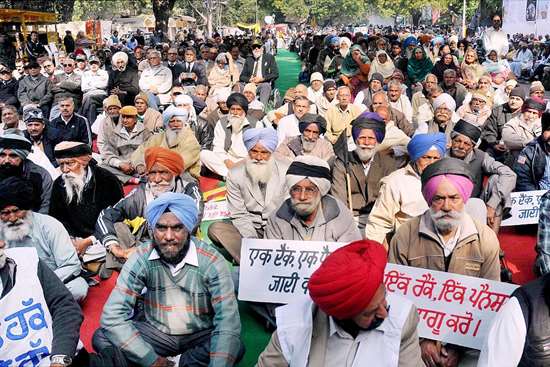
Ex-Servicemen protest against the delay in implementation of "One Rank One Pension" at Jantar Mantar in New Delh
Achchey Din seems likely to dawn on the armed forces, or ex-personnel in particular. The government is giving final shape to their long standing demand of adopting One-Rank One-Pension (OROP).
Bureaucrats are currently burning midnight oil to pore over the fine print of at least four options to implement the OROP scheme. A source in government, aware of the developments, says a decision is expected soon and a large provision in the Budget, or soon after.
"We are very hopeful that the long overdue injustice to the armed forces will be reversed in this budget," says Maj Gen Satbir Singh (Retd) who leads the IESM or Indian Ex-Servicemen Movement, which lobbied intensely for OROP since 2008. "Both UPA and NDA have agreed to our OROP so we see no reason that it will be held back now," he says.
For 40 years the retirees, now numbering three million, have been bristling under what they perceive as "neglect and humiliation" by political parties and successive governments. Its extreme manifestation, from their perspective, was the denial of OROP. Lack of empirical data on the cost of this pension, plus political reluctance of the parties fuelled much of the denial and delay. The former military staff launched public agitations to make their case, often embarrassing the government.
Regardless of which of the four options the government decides upon ultimately, the roughly Rs 8,000 crore likely to be set aside for OROP should go a long way to calm the angry (wo)men in uniform, besides providing them a lifestyle befitting the status, say, one that a retired colonel or brigadier enjoys.
One choice before the government, says the same government source, is to do exactly as the ex-servicemen want: Give future and past retirees of the same rank from the Army, Navy and Air Force exactly the same pension. Essentially, this means that all Brigadiers or, say, Air Vice Marshals, would get the same pension regardless of when they retired, taking into account only their years in service and the number of years they held the rank. This formula, a literal interpretation of the phrase One-Rank One-Pension, has been accepted by government committees, including the Parliamentary Standing Committee on defence.
For instance, a colonel with 30-32 years of service, whose basic pay was around Rs. 26,000 before 2004 would have earned around Rs. 37,000 in 2014. OROP is expected to bridge the pension gap that arises due to this pay discrepancy. "Our demand is very simple: Today's pension for all previous retirees," says Singh.
But the government's estimates of cost of this pension have it pedalling back a little. Taking 2012 as the cut-off date, giving past retirees hikes that bring them on par with the highest pension paid to that rank in 2012, would cost a whopping Rs 16,000 crore, they argue. This has prompted a hunt for other options, meant to "balance" the exchequer with meeting armed force expectations.
A second option involves fixing the pension for pre-2006 retirees according to the 6th Pay Commission. Then, the government may pull a trick out of its hat and select the lowest pension paid since 2006 as the norm for older retirees. A version of this formula is already under implementation for Junior Commissioned Officers, Non-Commissioned Officers, and other ranks. It's possible this formula, with some tweaks, will be accepted, and result in the roughly Rs 8,000 crore allocation.
"It's obvious OROP is going to happen," says this government official. The discussions, this person says, is now in its final stage. There was a third choice, which involved bringing all ex-servicemen on par with the basic pay of the 6th Pay Commission, then calculate each retiree's pension individually, taking into account each one's years in service and length of time spent in the rank. This option is an "administrative nightmare" dogged, reportedly, by unavailable past data with the Controller of Defence Accounts, a wing of the ministry of defence. The lack of data is also a clear sign that the OROP debate has been based on weak databases and much groping in the dark.
A fourth and final option is where pension is to be fixed on the basis of an average or median. Separate groups of retirees who superannuated in bands of years, say, between 1990 and 2000, would be made. Those earning a pension below the average would get an enhanced pension, while the rest would be protected. This option, apparently easy to implement, is technically not OROP at all as it implies a different pension for retirees in the same rank, if they retired at different points of time.
The defence forces are mounting tremendous pressure on the government to ensure OROP isn't watered down. Earlier this month, they questioned defence minister Manohar Parrikar for saying that OROP would satisfy them "80 per cent." Their vociferous protest had the government assure full satisfaction. In 2009, angry retired armed personnel signed a petition in their own blood for then President Pratibha Patil. Reeling under such tough tactics, the UPA finally accepted OROP in 2012. But the Rs. 500 crore for it in last year's interim budget presented by finance minister P Chidambaram was seen as woefully inadequate. The veterans switched sides, now pinning their hopes on to the BJP's then prime minister-aspirant, Narendra Modi.
Five lakh ex-servicemen had assembled last spring at Rewari, on the outskirts of Delhi, to hear Modi promise OROP, should his party form the government. Behind the scenes, the ex-servicemen had already got an assurance from the party to consider their demand and publicly announce it, as a precondition for pulling in the spectacular crowd in Rewari. "For years we had requested, protested and demanded OROP. In 2014 we realised what would make a difference to politicians—votes. With our strength and influence over the village population, we could swing elections in many places," Gen (retd) Singh says.
OROP is an issue which could trip the BJP. It considers and projects itself as a fiercely nationalist party, a narrative meaningless without a robust national defence policy. It can scarcely afford to disappoint the defence forces. Nevertheless, the different versions of OROP indicate just how conflicted the issue is. The ex-servicemen never agreed that OROP will cost the Rs. 16000 predicted by the bureaucracy. They still hope for a Rs. 9000-12000 crore allocation for full OROP. The usually docile military retirees started getting heated up only after 2006. That year, the Sixth Pay Commission hiked central government pay significantly, to counter the private sector's fantastic offers to the similarly educated. As pension is always a proportion of salary, after this hike, the gap between pensions of ex-servicemen who retired before and after 2006 grew wider. Most jawans retire in their mid-thirties, and only an eighth of officers rise beyond the rank of colonel. The belief that the army would never catch up with the civil services' benefits also grew.
"There has been an obvious and clear neglect of our concerns vis a vis civil services," says Col. Karan Kharb (Retd.), who recently wrote in several journals about rising expressions of discontent within the Army. "One of the biggest reasons for discontent is not implementing OROP." He says that the promotion pyramid, even after reforms since the mid-2000s, is so narrow that officers promoted to higher ranks often don't get deployed in that rank's position. "We need a motivator. The government must see to it that the armed forces are looked after exceptionally well, not just in comparison with the civil servants," he says.
Since 1951, the army argues, it has clambered down five steps in rank status, compared with the police and civil services. For instance, an SP was equivalent of a Captain in the army at the time, a joint secretary a major. Now, a joint secretary matches a major general and an SP a colonel. "We are not asking for money, the pension is simply a corollary to our pride being restored," says Cdr SS Ahuja, (Retd) from the Indian Navy.
Other than the three million already-retired personnel, some 60,000 retire from military service every year fuelling speculation in the bureaucracy of an unmanageable financial liability, and that OROP will encourage other para-military formations to raise similar demands. "There is a perception among the armed forces that India is not treating them with due respect. Given the parallel perception that the forces are critical to India's security, this debate has arrived at a juncture where some concrete step will have to be taken," says Prof Mukul Asher, a professor specialising in social security issues in Asia at the Lee Kuan Yew School of Public Policy, Singapore.
Asher says pension appears to be taken as a separate item, with nobody examining the total cost of an employee in the armed forces, including after retirement. The "peculiarity" of adjusting pensions against pay commissions makes the system even more complex, he says.
Indeed, Gen Singh (Retd) and his IESM colleagues trace their mistreatment back to the 3rd Pay Commission in 1973. That year, for the first time, civilian and military salaries were "clubbed". Until 1973, civilian pension was 33 per cent of last salary drawn. Officers, at the time, drew 50 per cent of their last salary as pension while Jawans or Junior Commissioned Officers got 70 per cent. After 1973, civilian pension grew to 50 per cent of last pay drawn, while retired jawans and JCOs pension was cut to 50 per cent.
To illustrate, the pension of the highest civilian authority was Rs. 416.50 in 1973 and increased to Rs. 45000 in 2006. The army chief in 1973 was entitled to Rs. 1000 pension, which is now Rs. 45000. "So, the civil services have given themselves a 108 per cent hike over these years and given us only 45 per cent. Why? Who gave them this authority?" says Gen. Singh.
Since 2004, most new government employees, though not armed forces, moved to a new system where pension contributions are defined and not benefits. "Pensions to existing retirees cannot be changed but this does not mean that in future some new employment contract cannot be drawn up. This is the kind of decision that needs to be taken," says Asher.
For now, nobody really seems to know what OROP should, or will, cost and the call seems to depend on immediate affordability rather than long term considerations. As the government official says, the payout in the budget will be a political decision for the Modi government.
(Source- OUTLOOK)

O.R.O.P. : आज का ताज़ा खबर

17.2.15

Further to the information given in the report of rally held on 1 Feb 15. On 1 Feb 15 a delegation of 30 ESM including four veernaris met RM at Kotah house. RM had promised to take action on OROP latest by 17 Feb 15.

IESM has a good news for you. Your dream of OROP has moved a step closer to its approval. 

As promised by RM to IESM delegation that he will personally monitor the progress on OROP.  True to his promise he has chaired a meeting today of OROP action committee. The meeting was attended by CGDA,DESW, MOD and Army pay cell Maj Gen Aggarwal and Col Pruthi. Col Rathore also attended the meeting. It is confirmed that OROP file has finally reached MOD.

Following decisions have been taken in the meeting today 17 Feb 15. 

1.OROP will be as per approved definition.

2.In most of cases ESM will get fixed at highest of their rank pay band. 

3.OROP equalization will be done annually. 

4.Some issues of Major's pension are under discussion and will be sorted out soon.

RM gave special instructions to Gen Aggarwal to inform Gen Satbir singh about this development. Gen Aggarwal informed IESM asap he came out of the meeting. File is under final scrutiny and preparation and file will be dispatched to MOF on 23 Feb as RM is going to attend Annual Aero Show at Bangaluru from 17 to 22 Feb.

CGDA has already issued circular no 536 giving increase in pension of widows w.e.f. 24 Sep 12. This circular fixes the pension of widow at 60% of the pension of the ESM as given in circular 500. Widows will get this enhanced pension from 24 Sep 2012. They will further get arrears from 1 Jan 2006 as and when the MOD issues such instructions. 

Dear Members hold your celebration till budget. We will finally come to know how much funds get allotted for OROP in this years budget and will raise a toast for OROP on that day.

IESM salutes sincerity of RM Sh Manohar Parrikar. He is a man of his words. He had promised action on OROP by 17 Feb and he has executed it.


(Source-Vasundhra blog)

================================================== 

Govt likely to categorise 'military pension' separately 

Last Updated: Tuesday, February 17, 2015 - 19:41

It seeks to ensure that a uniform pension is paid to defence personnel who retire at the same rank with the same length of service, irrespective of their date of retirement.
(Source- Zee News-PTI)