Saturday, August 29, 2015

OROP - ENOUGH DEFENSIVE POSTURES SO FAR. SOME ATTACKING STRATEGY? A VETERAN'S VIEW

DEAR ALL,

PLEASE SEE THE BOTTOM E-MAIL OF COL YC VETERAN.

NOW IT IS TIME TO FOCUS ON OTHER ITEMS THAN O R OP 

WE DID NOT RAISE THE IMPORTANT ISSUES FROM POST-1971 , AND LANDED US IN THIS DIPLORABLE SITUATION:

NOW OUR DEMANDS WITH THE GOVT SHALL AND WILL BE :

1. RESTORE STATUS OF PRE-1.1.73 ON PAY, PENSIONS AND STATUS

2. SEPARATE PAY COMMISSION FOR AF BE CONSTITUTED

3. WITHDRAW NFU (A PAY FOR NON-FUNCTIONING)TO CIV OFFICERS WEF 1.1.2006.

5. WITHDRAW 25%BP FOR THEM FOR SERVING IN NE/J&K STATES AND EXTEND THIS FACILITY TO ARMED FORCES PERSONNEL

4. SEPARATE BUDGET FOR ARMED FORCES LIKE THE RAILWAYS.

5. NO CIVILIAN CONTROL ON THE ARMED FORCES EXCEPT THE POLITICAL CLASS

6. APPOINTMENT OF CDS (FROM AMONGST THE THREE CHIEFS) WITH THE RANK OF FIELD MARSHAL, TO BE EQUIVALENT TO THE CABINET MINISTER STATUS (TO BE APPOINTED INTO THE COUNCIL OF MINISTERS BY THE PM ON FORMING GOVT). SIMILAR ARRANGEMENT BE MADE IN THE STATES BY THE GOVERNOR/LG IN STATES/UTS\ APPOINTING THE RETIRED COAS/CNS/CAS/COMMANDERS RANK OFFICIALS)

7. CONSTITUTE ARMED FORCES VETERANS WELFARE COMMISSION WITH POWERS AKIN TO SC/ST COMMISSION) 

AND ANY OTHER ISSUE CONSIDERED APPROPRIATE BY ESM GROUPS  

 VETERAN BLOLGGER
=======================================

'We hv seen unending efforts of IESM on negotiations & mean & meek approach of Babudom. While we admire every bit of initiatives but like talks with PAKIS, the approach needs a relook. 

Parity on NFU/OROP or whatever needs to be agressively propounded. Indian CRAB story pays because threat is reversed. If one goes up, let 10 to pull him down.

PM to be told that let NFU be withdrawn retrospectively & CPC decide on new Pay methodology taking base of 2nd CPC & fauji pay scales/Pension.


Babus shall be seen as headless chickens to defend & get exposed.


Trade unions to be juxtaposed for definition & equivalence with Babu Cadre. 

Do this on one forum & see the counter threat. 


Defencive position is OK but a counter offence is necessary as in 65/71 war & not like KARGIL to retrieve what u hv lost.

COL YC

===============================================

(VIA E-MAIL FROM COL YC VETERAN)


"What about your Children?" - A CONVERSATION BETWEEN A BUSINESSMAN AND A VETERAN

DEAR ALL

READ THE FOLLOWING CONVERSATION.

IT IS TIME NOW TO SEND OUT OUT A DETAILED ADVT INFORMING THE PUBLIC 

AS TO WHAT THE ARMED FORCES DO TO THE COUNTRY AND WHAT THE 

NATION OWES THEM AND ACTUALLY PAYS THEM FOR THEIR SACRIFICES.


THE UNITED FROM OF ESM/IESM MAY THINK OF A SUITABLE INFORMATION 

/PROPOAGANDA/ADVT  ETC TO THE GENERAL PUBLIC ON THE ISSUE

THANKS

A VETERAN BLOGGER
=======================================================================

A conversation between a businessman & a veteran went something like this:-

"So, Sir, You were in the Air Force. That's very nice. 'Wahan to khoob liquor free milta hai. Aur woh CSD bhi to hai' Wahan se to bhi aapko bahut kutch muft milta hai' , You must have really had a ball. 'Aap to bhai Govt ke damaad hain!'

-No it's not like this. We lead a very tough life and have a disciplined way. We get nothing for free. Who is telling you all this?

-Chaliye, jaane deejiye, Yeh bataiye, ki aap ke bachhe kya karte hain?

-Mera beta hai aur woh MBA karke MNC mein kaam karta hai.

-Oh! To aapka beta Air Force mein nahin gaya. This is not fair. 'Ab hamare desh ke liye kaun marega'-'Who will die for our nation?' Isn't it your tradition that the families must remain in the defence & die for our nation?

The Air Veteran was quite angry but holding himself back, he just asked " What about your children-What are they doing?

-Oh! they are Govt Contractors. We are all enriching ourselves and thus enriching the country. Don't we have to pay for your dying?"


This is the general feeling that some may have, but the symptoms are seen in all writings. Lately, it seems, even the Presstitutes have taken it upon themselves to suggest denial for our legitimate demands. The editorials in today's newspapers are appealing to the sense of patriotism for dropping the demands of the OROP. Every line written there is nothing but disinformation and the General public is quite likely to believe the printed word. One media house has gone on to suggest that nobody should serve in the defence forces for more than six years. This will wipe out all demands for any OROP.

The politicians are the only ones who are commemorating the 50th Anniversary of the 1965 war. One 'worthy' has stated that the war was won because the country was lead by the members of a particular party, very conveniently forgetting the fate that we met with just three years earlier.

Everyone 'bows' to the dead. These dead also have to be 'unknown', otherwise the politicians/ Babus will be required to answer their families. Thus, it is not convenient to build a war memorial to honour those whose names are known.

The AFA very strongly recommends that the Services and the Veterans need to educate the general public. The Battle of 'Perception' is today more important than the continuous fighting with the enemy, both across the borders and 'within'.

We also have to learn to honour our own.


Veteran Wg Cdr Dinesh Bharat
N-9/2, DLF City, Phase 2, 
Gurgaon 122002, Haryana
9350536379,9717431909

(SOURCE- VIA FACEBOOK A/C OF AFA/E-MAIL)
=================================================

OROP - 'To compare bureaucrats to those in armed forces is laughable'

Service in the Armed Forces can’t be compared to government service. If that basic premise is not accepted, then there’s no scope for any debate on OROP’
‘No one joins the Armed Forces on a contract. They join to serve. Armed Forces attract those who want to serve, not based on financial terms and contracts’
Rajya Sabha MP Rajeev Chandrasekhar, a passionate advocate of OROP, speaks to Sudhir Bisht.  
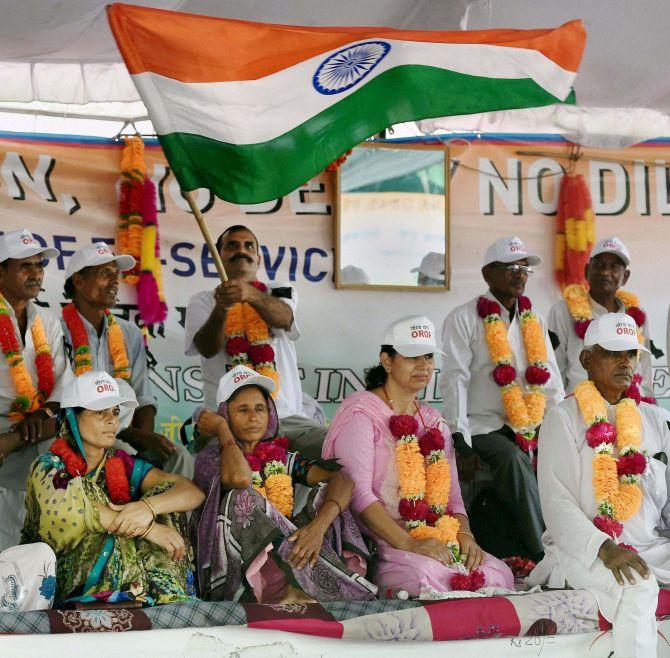
Ex-servicemen and their families continue their protest demanding OROP at Jantar Mantar, New Delhi. The protest has now been on for 75 days. Photograph: PTI
Rajeev Chandrasekhar is a passionate votary of One Rank, One Pension and has been championing the cause since 2006 vocally within and outside Parliament.
He has taken over 60 major initiatives inside and outside Parliament including 25 interventions, 30 letters to government, 12+ articles in the media and dozen meetings with ministers and veterans.
Most recently, on August 24, 2015, he was the only politician who visited Jantar Mantar and expressed his solidarity with and support to the protesting veterans, their family members and to OROP.
The member of Parliament spoke to Sudhir Bisht.
It has become politically incorrect to question the implementation of One Rank One Pension, but there are several government employees who feel that they will lose out if the scheme is implemented. What is your take on it?
It is not politically wrong to ask questions but they do not understand the very different service conditions our armed forces endure.
Is it not important to make a distinction between officers and jawans? Officers retire at the age of 54, with two extensions. A jawan, on the other had, retires at 38. Hence, isn’t the premise that all armymen retire young wrong and the portrayal of the same incorrect?
Most of the benefits of OROP are for jawans and war widows. The bulk of the armed forces do retire young and OROP is a legitimate right.
Officers are a very small percentage of the total strength of the armed forces. Besides this, the ethos of the armed forces is based heavily on honour and respect to seniority. The fact is that there shouldn’t be differences or divisions between terms of officers and men, their nature of service and risk and the fact that OROP was a norm for many years is reason that officers also have a right to OROP.
Why is it surprising that a retired major general gets a pension less than a young retired colonel? This happens everywhere, all the time. A retired Central Reserve Police Force commandant who is 75 years of age will get lesser pension than an assistant commandant who is 60 years of age. A retired deputy secretary who is 80 gets 20 per cent less pension than the under secretary who is just 60 and has just retired. The logic for OROP for people retiring at different times doesn’t make any sense.
As I said earlier, comparing the armed forces to the paramilitary forces or any other government service is the argument that the governments of many years have used to justify the denial of OROP.
The basic premise of OROP is the recognition that serving in the armed forces is different in many ways. If that basic premise is not accepted, then there’s no scope for any debate on OROP.
Rajya Sabha MP Rajeev Chandrashekhar
The Indian Army does a great job for its citizens. So does the CRPF, the Border Security Force and Indo-Tibetan Border Police. The officers of these paramilitary services compulsorily retire at 57 if they don’t get the DIG grade. How is it then that only army officers can be given the OROP benefit?
Like I said before, Army officers can’t be separated from the men they command and lead into battle and conflicts. These arguments have been debated endlessly before, including to a parliamentary committee on petitions (Koshiari committee) and addressed. The armed forces are not the same as the paramilitary forces. They differ in many fundamental ways
When these retired officers joined their respective jobs, they entered into a contract. The contract didn’t say that they will get One Rank One Pension. To force it upon the government is an act of negotiation, just as any union or association would pursue with its employers. This makes OROP a subject of negotiation and NOT a matter of right, as is being portrayed.
I disagree. OROP became a promise that was made and committed. There is not much to negotiate on OROP, except perhaps the terms of the payment in keeping with the government’s economic situation. To many in the armed forces, this is a right.
No one joins the armed Forces on a contract. They join to serve. Armed forces attract those who want to serve not based on financial terms and contracts. To think so, betrays a lack of understanding of what makes men in the forces tick.
And, nothing is being ‘portrayed’. It’s a simple issue of principle to those who serve and to those in our country who value the ideals of service to nation. Veterans have been asking for this for several years and the current situation is the culmination of decades of frustration. It is not a ‘portrayal’ to see repeated instances of apathy to the overall cause of veterans and a system that has remained apathetic to normal dignified requests all these years.
If OROP is implemented for the armed forces, the paramilitary too shall demand the same. And why not? It is well known that a high number of General Reserve Engineer Force/ Border road workers die due to frost bite or cold while working in high altitude road projects, many more than the number of soldiers who die during border skirmishes. Why should GREF personnel not demand OROP? Why should the fire services not demand OROP?
Like I said, there’s nothing preventing people asking or doing things. But as I have answered, this is a bogie, a red herring raised for several years. Prime Minister Narendra Modi has already committed to this because he has no doubts of the very different service conditions of the armed forces. Additionally, this is not to say that the other forces do not deserve improvement in their terms, but clearly none that justifies OROP.
Government servants who joined after 2004 are no longer entitled to a guaranteed minimum pension by the government. In light of this, shouldn’t any formula given by the government be welcomed by the armed forces, as the days of guaranteed pension are over?
I hesitate to say this, but say it I must. A bureaucrat is no way comparable to a man or woman who serves in the armed forces. Nowhere is this comparison even attempted, not in the United States, the United Kingdom or even China. It’s laughable and making that comparison is ludicrous.
Countries like the US and UK and most other advanced democracies, with armies that are facing conflict, venerate the men and women who serve.
The UK parliament has even passed a law called Armed Forces Covenant (the Armed Forces Covenant is the expression of the moral obligation that the government and the nation owe to the armed forces community. The covenant acknowledges that members of the armed forces sacrifice some freedoms and often face dangerous situations. It recognises that families play a vital role in supporting the operational effectiveness of the armed forces). It is only in India where our men and women have to go through the humiliation of a comparison with a discredited bureaucracy.
Sudhir Bisht is a published author and a freelance columnist. 

(SOURCE - REDIFF.COM)

30 साल की मुराद, बनाम 10 हजार परिवार


पूर्व सैनिकों के लिए यह मांग बेहद अहमियत इसलिए रखती है, क्योंकि 33 साल की उम्र में रिटायर होने के बाद बाकी उम्र पेंशन पर ही गुजारनी होती है। वन रैंक वन पेंशन मतलब अलग-अलग समय पर रिटायर हुए एक ही रैंक के दो फौजियों को समान पेंशन देना। फिलहाल रिटायर होने वाले लोगों को उनके रिटायरमेंट के समय के नियमों के हिसाब से पेंशन मिलती है। यानी जो लोग 25 साल पहले रिटायर हुए हैं उन्हें उस समय के हिसाब से पेंशन मिल रही है जो बहुत कम होती है।

फौजियों की मांग है कि 1 अप्रैल 2014 से यह योजना छठे वेतन आयोग की सिफारिशों के साथ लागू किया जाए। सेवानिवृत्त कर्नल केसी मिश्र का कहना है कि हमें तो 33 साल पर ही रिटायर कर दिया जाता है, और उसके बाद सारा जीवन हम पेंशन से ही गुजारते हैं। जबकि अन्य कर्मचारी 60 साल तक पूरी तनख्वाह पाते हैं। ऐसे में दूसरे विभागों को न देखते हुए सैनिकों को यह सुविधा मिलनी चाहिए। रिटायर्ड सैन्यकर्मी लंबे समय से यह मांग कर रहे हैं। इसे लेकर कई पूर्व सैन्यकर्मियों ने अपने पदक लौटा दिए थे। इसकी पहली वजह यह है कि अभी सैन्यकर्मियों को एक ही रैंक पर रिटायरमेंट के बाद उनकी सेवा के कुल वर्ष के हिसाब से अलग-अलग पेंशन मिलती है।

छठां वेतन आयोग लागू होने के बाद 1996 से पहले रिटायर हुए सैनिक की पेंशन 1996 के बाद रिटायर हुए सैनिक से कम हो गई। इसी तरह 2006 से पहले रिटायर हुए मेजर की पेंशन उनके बाद रिटायर हुए अफसर से कम हो गई। मांग उठने की एक वजह यह भी है कि चूंकि सैन्यकर्मी अन्य सरकारी कर्मचारियों की तुलना में जल्दी रिटायर हो जाते हैं, इसलिए उनके लिए पेंशन स्कीम अलग रखी जाए। बकौल मिश्र 30 साल पहले एक्स सर्विस मैन एसोसिएशन बनाकर मांग उठाई गई। 2008 में इंडियन एक्स सर्विसमैन मूवमेंट (आईएसएम) नामक संगठन बनाकर रिटायर्ड फौजियों ने संघर्ष तेज किया। जो अब निर्णायक दौर में पहुंचा है।
-------------------------
इसलिए होती रही देरी
- सरकार को इस बात का भय है कि आर्मी, एयरफोर्स और नेवी के लिए यह योजना लागू करने के बाद कहीं दूसरे अ‌र्द्धसैनिक बलों (पैरामिलिट्री फोर्सेस) की तरफ से भी इस तरह की मांग न उठे।

हालांकि केंद्र ने अब इस पेंशन योजना के लिए अलग प्रशासनिक और आर्थिक ढांचा तैयार कर लिया है।
--------------------------
कब क्या-क्या हुआ
- 1973 तक सेना में वन रैंक वन पेंशन थी। उन्हें आम लोगों से ज्यादा वेतन मिलता था।
- 1973 में आए तीसरे वेतन आयोग ने सशस्त्र बलों का वेतन आम लोगों के बराबर कर दिया।
- सितंबर 2009 में सुप्रीम कोर्ट ने सरकार को वन रैंक वन पेंशन पर आगे बढ़ने का आदेश दिया।
- मई 2010 में सेना पर बनी स्थाई समिति ने वन रैंक वन पेंशन लागू करने की सिफारिश की।
- सितंबर 2013 - बीजेपी के प्रधानमंत्री पद के उम्मीदवार नरेंद्र मोदी ने प्रचार के दौरान वन रैंक वन पेंशन लागू करने का वादा किया।
- फरवरी 2014 - यूपीए सरकार ने इसे लागू करने का फैसला किया और 500 करोड़ रुपए का बजट आवंटित किया।
- जुलाई 2014 - मोदी सरकार ने बजट में वन रैंक वन पेंशन का मुद्दा उठाया और इसके लिए अलग से 1000 करोड़ रुपए रखने की बात की।
- फरवरी 2015 - सुप्रीम कोर्ट ने सरकार को तीन महीने के अंदर वन रैंक वन पेंशन लागू करने को कहा।

(SOURCE-JAGRAN)-See more at: http://www.jagran.com/uttar-pradesh/basti-12791669.html#sthash.VL0hgoJl.dpuf

Dear Colleagues,

An artful negotiator always deliberately mixes  unimportant issues with important ones in the agenda. He then uses the former as a bargaining chip while his focus stays fixed on the crunch point. The ongoing OROP parleys follow the same pattern. While the date of applicability and the base year involve one-time payments and are relatively less critical, the main  issue of principle is the yearly increase in pension. 

In the simplest terms, the accepted definition implies, 'old and new pensions must be equated and must be kept equated in future'. These two postulates comprise the basic principle. The term 'yearly', as it pertains to pension revision, is not our creation. It was the Sixth Pay Commission that ordered salary increase of 3% every year.  This being the crunch of the definition cannot be negotiable. Any change in this postulate would mean whatever is given is not OROP but a mere enhancement in pension similar to what the UPA government also gave in their tenure. Any talk of changing this frequency to three or two years, even on the facile pretext of 'as long as a senior does not get lower pension than a junior', should be anathema. That aberration occurred only in case of Major Generals and was related to rank pay. It has no connection to OROP. 

The only concession that can be made is to give the government some more time if they want, even though they have already had enough time to work on OROP. Even this time period should be spelt out in specific terms. OROP has been in progress for many decades and  another few days or weeks may not matter. Delay can be acceptable, dilution of definition must not be.
  
It needs recalling that OROP was a dormant issue till the IESM was founded in 2008. It took the IESM six years of struggle, including hunger strike, medal return, police detention, rallies, memoranda, presentations etc, to get it finally approved by the government. It was also not an easy task to get the final definition accepted and inserted in the Koshyari committee report. Thousands of veterans spread across the country, who have contributed to those efforts, and who are neither on the net nor on the social media, have their aspirations tied to OROP and are eagerly expecting the outcome. It is imperative that they do not feel betrayed.

It would be advisable to involve some JCOs/Other Ranks in the negotiating team.  Asking for raise of hands at Jantar Mantar retrospectively and conveying it as a unanimous decision of veterans should be an avoidable illusion.

I feel sad that at this critical time I cannot be in Delhi. My elder brother, Colonel Mohinder Kadyan KC, has undergone surgery to have a duodenum tumour  removed and I am with him in the US.

Lt Gen Raj Kadyan
Chairman IESM
 Advisor UFESM

(SOURCE- VIA E-MAIL FROM COL NK BALAKRISHNAN (VETERAN) 

OROP - DECISION DELAYED IS DEFENCE DENIED

If armed forces veterans feel let down, it is because the delivery on the OROP promise has been in inverse proportion to the articulation of the promise itself. 

Each day Govt delays the implementation of the OROP scheme, a demand that is 42 years old, it risks playing with fire. It is safe to assume that the serving service Chiefs have conveyed as much to the Govt. The public manifestation of rapidly spreading and quickly deepening levels of disenchantment came when the daughter of Gen VK Singh, former COAS and a serving Min of State, sat with the Jantar Mantar agitators in an open show of support. Mrinalini Singh’s husband is a serving Army officer. This is a categorical indication that both Gen. Singh and Col. Rajyavardhan S Rathore, another Min, would no doubt have pointed out to the Govt the consequences of not being able to deliver on a promise already made several times over.

Uncertain future

Roughly 60,000 people retire from the armed forces every year. Some retire before they are 35, and as many as 87 per cent of servicemen retire between the ages of 34 and 48. Soldiers, sailors, airmen at the lowest level are the hardest hit because after a near nomadic life in the armed forces, they most likely do not own too many assets, a home nor have an alternative income stream. They have no clear prospect of a second lease of working life either. 

Soldiers retire early because they need to be fighting fit to be in the forces and hence, the armed forces need young blood. The retirement policy affects an estimated 25 lakh ex-servicemen. Counted along with their dependents, the number swells to roughly three times that or 70 lakh people.

Also, a large section of the armed forces has family members who are either still serving or have retired from the forces. In normal conversations, the situation is bound to occupy their mindspace. Those in service know that sooner or later, they will become veterans and inherit the same situation their fathers did before them, an inheritance of loss.

The problem has been exacerbated because of the way in which the then BJP prime ministerial candidate, Narendra Modi, appropriated and espoused the cause at the 2014 hustings and his subsequent repeated assurance, both on the floor of Parliament and elsewhere, that OROP was a settled matter and the solution had his imprimatur. Consider also Mr. Modi’s unparalleled political heft in the Lok Sabha and the fact that the Supreme Court has, as long ago as December 1982, underlined the need for OROP. If the agitators feel let down, it is because the delivery of the promise has so far been in inverse proportion to the articulation of the promise itself.

Deliberately tangled

As many as ten retired service Chiefs have deliberately used the word ‘imbroglio’, a word of Italian origin that has elements of confusion, entanglement, bitterness, and complication all rolled into one. It accounts for the growing feeling that in the real OROP narrative, Narendra Modi, whom none other than the Vishwa Hindu Parishad’s Ashok Singhal acknowledged as BJP’s Iron Man, is helpless. His inability to deliver stems from his being a victim of either intra-party politics or from him having been ensnared in a web made by intransigent bureaucrats.

The discourse in New Delhi circles suggests that a section of the bureaucracy wants to dovetail the OROP with the Seventh Pay Commission. This would effectively scupper the plan because it would postpone the resolution and rework the rationale and framework of the OROP as well. Lt. Gen. Syed Ata Hasnain, who retired as Military Secretary of the Army, writes in the July issue of Fauji India that the “bureaucracy is living up to its promise to complicate the issue to such an extent that it [OROP] is once again shelved without decision.”

The procrastination has escalated the situation to a standoff between the veterans and the Govt. Mr. Modi’s inability to act quickly and effectively has allowed other political parties space where none need have been conceded. The issue is now open to political hijack. There has been a steady stream of contradictory noises emanating from the government, most notably from the Finance Ministry, asking ex-servicemen to “lower expectations”.

The implication is that the Govt is having trouble coming up with the money. It has not gone unnoticed among the veterans that Mr. Modi, the politician, had no difficultly promising Rs. 1.25 lakh crore for Bihar in what amounts, scandalously, to pre-election sops. For OROP, the figure being talked about is roughly Rs. 8,300 crore, a fraction of the Bihar pledge.

Soldiers cannot go on strike like bank employees do, but patience now seems in short supply. Since June, the veterans have resorted to black armband protests, bike rallies, candle-light vigils, petitions, the return of service medals, and hunger strikes in an attempt to force the government to focus on the implications. 

They know more than others that all it requires is a small spark to set off a blaze. If something has been building up for a long time and is looking for release, even something as inconsequential as a slap can have an enormous ripple effect.

We need to remember the mutiny witnessed after Operation Blue Star. Given that the veterans are already on hunger-strike and writing petitions in blood, all it needs is a momentary provocation to set off that dreaded spark.

(Source - The Hindu - sudarshan.v@thehindu.co.in )